
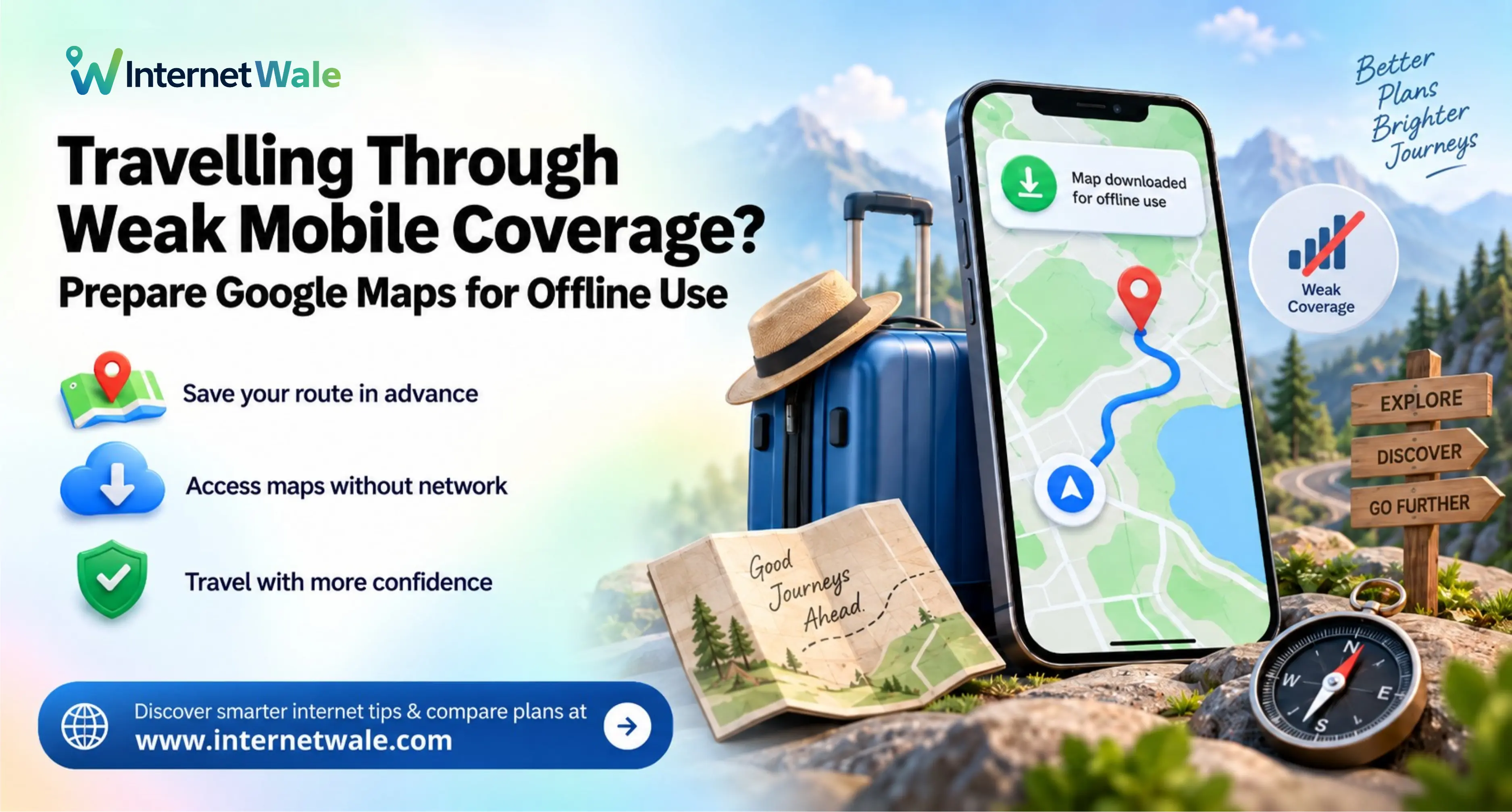
You have checked the hotel address and planned the drive, but the map starts loading just as the mobile signal weakens. Downloading the right area before leaving home can make that moment easier to handle.
Google Maps offers offline maps for Android and iPhone. The useful preparation is to choose your area, finish the download and check what works before you need it. This guide explains the setup, its limits and a practical pre-trip routine.
1. Download your map while you have internet
Connect your phone to your home Wi-Fi and open Google Maps. On Android, sign in; on iPhone, leave Incognito mode before downloading. Google's offline-map walkthrough describes this shared method:
Step 1: Tap your profile picture or initial.
Step 2: Open Offline maps and choose Select your own map.
Step 3: Move and resize the selection around the area you need.
Step 4: Review the estimated download size, then tap Download.
Wait for completion and check the saved area in your offline-map list. Do this on the phone you will carry. If another family member will handle navigation, prepare their phone too instead of assuming your download is available on every device.
2. Include the journey, not just the hotel
Google's Android guidance says the entire route must lie inside the downloaded map for offline guidance.
For example, imagine a family driving from Delhi to a hotel outside Jaipur. Selecting only the streets around the hotel does not cover the drive between the cities. Before downloading, review the planned journey and the places where you expect to stop.
Our practical suggestion is to allow some room around your intended route, then check the actual coverage. Balance that margin against the storage estimate. A tightly cropped selection may miss a planned stop; selecting a huge area without checking its size can create an unnecessary download.
3. Know which directions need a connection
Offline maps support driving guidance within the saved area. Walking, cycling and public-transport directions are unavailable offline, as are live traffic information and alternative driving routes. Google's iPhone guidance confirms these limits too.
If your itinerary combines driving, a Metro journey and a walk to the hotel, plan those stages separately. Keep the station name, exit details and accommodation address available as reference notes. A downloaded driving map should not be your only preparation for the whole trip.
Leave extra time for an unfamiliar journey. Without current traffic information, do not treat the displayed arrival estimate as a promise that the road ahead is clear.
4. Update saved maps before travelling
Downloads need updating before expiry. Google says Maps tries to refresh areas over Wi-Fi when they are within 15 days of expiring. To update manually, open Offline maps, select an expired or expiring area and tap Update. Automatic updates can be enabled in that section's settings.
Make this a pre-departure check, especially if you downloaded the area for an earlier trip. Do not assume that enabling automatic updates proves the latest update completed. Check the map's current status while you still have time and connectivity to resolve a problem.
5. Try a short readiness check at home
We recommend a simple rehearsal while stationary. After the download finishes, briefly switch off Wi-Fi and mobile data while keeping location services enabled. Open Maps and request driving directions between two places inside the saved area.
Check whether the intended destination and route are usable, then restore your connections. Avoid running this check during a call, payment or another task that needs internet. It is a practical test of your preparation, not a guarantee that every part of a future journey will work identically.
If it fails, note the exact message. Check the download status, selected area and travel mode before deleting anything or reinstalling the app. Change one thing at a time so you can tell what helped.
6. A saved map does not fix an inaccurate location
Map availability and your phone's position are separate checks. Google's location-accuracy guidance explains that Maps uses GPS satellites, nearby Wi-Fi and cell towers to estimate location. Buildings and underground spaces can affect GPS accuracy.
A wide pale-blue circle around the location dot indicates uncertainty. If the dot is grey or absent, Maps may be showing your previous position. Keep location services enabled and follow the app's accuracy instructions when necessary.
For example, if your downloaded streets appear but your position is wrong inside a parking garage, repeatedly downloading the same map is not a useful first response. When safe, check again somewhere with a clearer signal before deciding the download failed.
7. Handle missing downloads and prepare the essentials
Some countries or regions do not support map downloads. Check your destination beforehand; a faster broadband plan cannot remove a regional restriction. If a download stalls, compare the required space with your phone's available storage and confirm that other online tasks work.
Keep the exact destination address and a contact number in an accessible note. Charge the phone and carry a suitable charging cable. Google's navigation guide notes that navigation uses the screen, speakers and location, all of which consume battery.
Set things up before driving. If directions conflict with signs, barriers or conditions you can see, stop safely and reassess instead of following the screen automatically.
Use home Wi-Fi to prepare for time offline
A useful evening-before routine is to finish map downloads, check travel documents and prepare any work you need on the journey. For writing without a connection, see our guide to setting up Google Docs for offline use.
If you are also reviewing your household connection, Compare Plans in Your Area through InternetWale. Compare total costs, data limits, router terms and provider support. InternetWale helps you discover and compare broadband providers; it does not supply connectivity. Confirm final terms and exact-address availability with the chosen provider.